Pelletized metal fuel
Compact aluminum fuel pellets built for safe storage, simple logistics, and high-density energy delivery.
Modular Clean Energy.
No combustion. Near-zero direct CO₂ from the reaction itself.
See the TechnologyWe set out to create a solution that works today. One that doesn't depend on unproven technology, site, configuration and approval requirements, or the luck of having the right geology under your feet. Its modular design starts at 2MW and stacks from there, so capacity grows with demand instead of ahead of it.
Power shouldn't be the reason you can't build.
See our mission in action





This project is funded by the Government of Canada through the Federal Economic Development Agency for Southern Ontario (FedDev Ontario).
Why GH Power
Designed to share value from energy and alumina.
A GH Power reactor runs on recycled scrap metal and water, producing 1 MW of heat and 1 MW of hydrogen energy per module, convertible to on-site electricity through fuel cells or generators. Units are factory-built and modular, with capacity added as demand grows. Each reaction also produces alumina with potential market value.
Our co-location model is designed to let partners share in the value of the alumina their reactor produces, offsetting installation cost and lowering long-run energy cost.
Compact aluminum fuel pellets built for safe storage, simple logistics, and high-density energy delivery.
A modular aluminum-water reactor designed to convert aluminum fuel into clean, reliable energy, heat, and hydrogen.
Usable thermal energy is captured for process heat and site facility usage.
Hydrogen is engineered for fuel-cell-grade use and designed to ISO 14687, subject to purification, testing and customer acceptance.
A recovery process that captures the aluminum-based byproduct for useful applications and future circularity.
A proprietary polishing and finishing step engineered to target alumina specification. Samples are available for customer qualification.
Invented, engineered and built in Canada.Built in Hamilton, Ontario.
How it Works
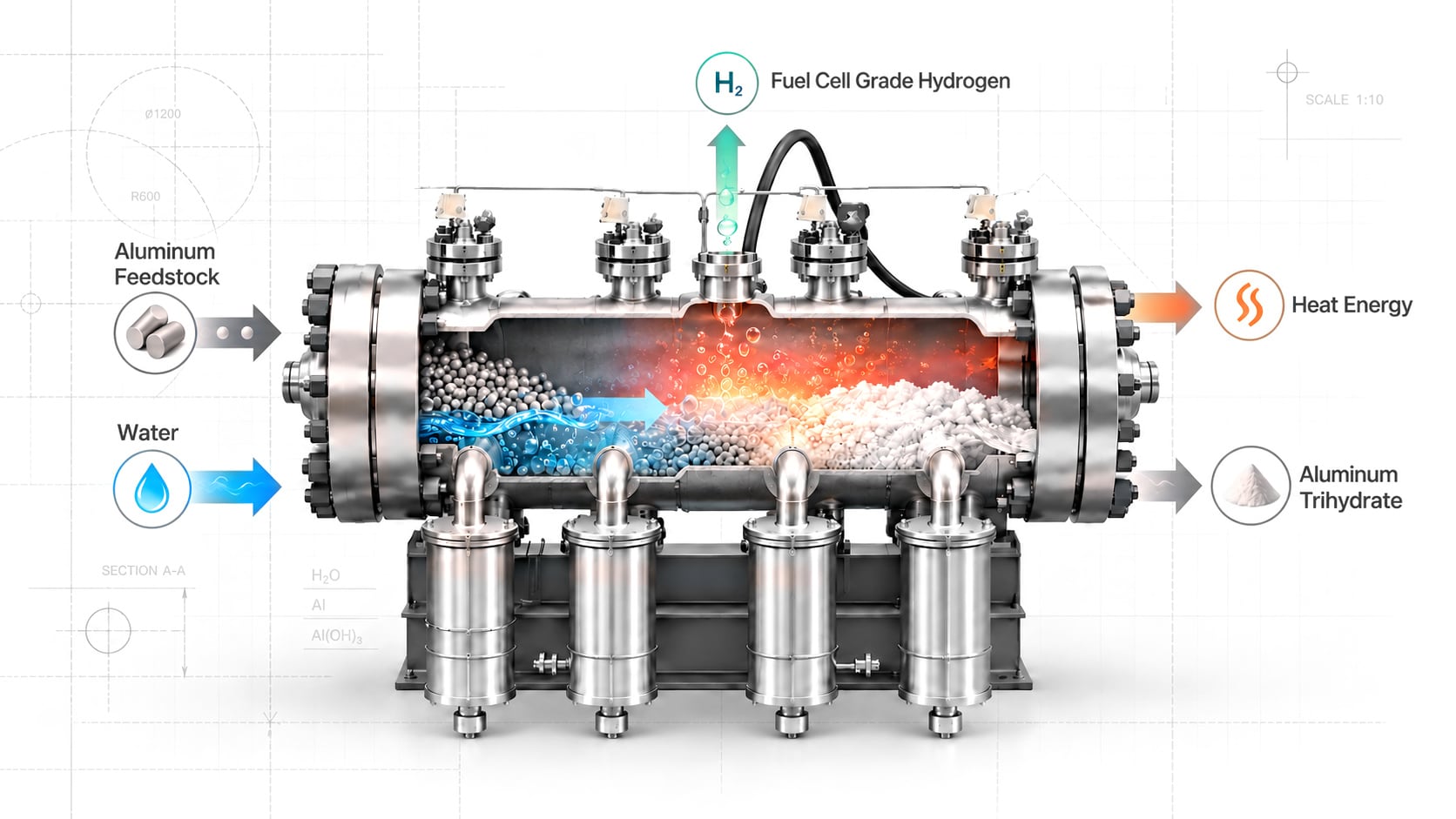
Used for additional on-site energy, or sold to offset energy costs.
Potential material value in a co-location model, subject to site-specific commercial arrangements.
*Typical timeline 12–24 months, depending on site, configuration and approvals.